
 Calvinism is a major branch
of Protestantism that follows the theological tradition and forms of Christian
practice of John Calvin and other Reformation-era theologians. Calvinists differ from
Lutherans on the real presence of Christ in the Eucharist, theories of worship,
and the use of God's law for believers, among other things. The term Calvinism
can be misleading, because the religious tradition which it denotes has always
been diverse, with a wide range of influences rather than a single founder.
Calvinism is a major branch
of Protestantism that follows the theological tradition and forms of Christian
practice of John Calvin and other Reformation-era theologians. Calvinists differ from
Lutherans on the real presence of Christ in the Eucharist, theories of worship,
and the use of God's law for believers, among other things. The term Calvinism
can be misleading, because the religious tradition which it denotes has always
been diverse, with a wide range of influences rather than a single founder.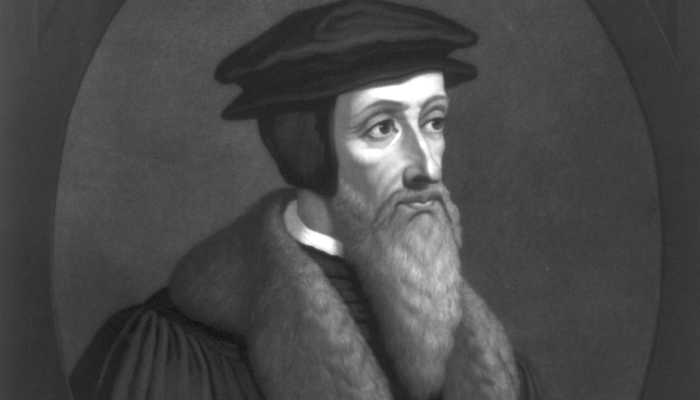
Religious
refugees poured into Geneva, especially from France during the 1550s as the
French government became increasingly intolerant but also from England,
Scotland, Italy, and other parts of Europe into which Calvinism had spread.

John Calvin was a French theologian, pastor and
reformer in Geneva during the Protestant Reformation. He was a principal figure
in the development of the system of Christian theology later called Calvinism,
aspects of which include the doctrines of predestination and of the absolute
sovereignty of God in salvation of the human soul from death and eternal
damnation, in which doctrines Calvin was influenced by and elaborated upon the
Augustinian and other Christian traditions.
After religious tensions erupted in widespread
deadly violence against Protestant Christians in France, Calvin fled to Basel,
Switzerland, where in 1536 he published the first edition of the Institutes. In
that same year. He continued to support the reform movement in Geneva, and in
1541 he was invited back to lead the church of the city.
Following
his return, Calvin introduced new forms of church government and liturgy,
despite opposition from several powerful families in the city who tried to curb
his authority. During this period, Michael Servetus, a Spaniard regarded by
both Roman Catholics and Protestants as having a heretical view of the Trinity,
arrived in Geneva. He was denounced by Calvin and burned at the stake for
heresy by the city council. Following an influx of supportive refugees and new
elections to the city council, Calvin's opponents were forced out. Calvin spent
his final years promoting the Reformation both in Geneva and throughout Europe.


The
Reformation officially began in 1517 when Martin Luther challenged the Roman
Church on the matter of Indulgences. While Luther had no idea of the impact
this would make on the German society and the world, this event changed the
course of history.

THE
CAUSE OF THE REFORMATION
There had
been numerous attempts to reform the Roman Church before the 16th,
but they had always been squelched by the Inquisition. They opposed the Roman
Church and their blood flowed like water in martyrdom. Rome herself made some
halfhearted attempts to reform at the Councils of Pisa (1409), Constance
(1414-1418) and Basel (1431), but these were not successful. There was a group
within the Roman Church called The Brethren of the Common Life that
came into existence around 1350 for the specific purpose of bringing reform.
God
appointed the 16th century to be the time of reformation, and had pre-pared the
Church in many ways for this reformation. Religious, economic and political
factors that had been brewing for centuries set the stage for the Reforma-tion.
The papacy was corrupt; monasticism and scholastic theology had declined;
mysticism was on the upswing; there was a revival of the Greek and Roman
classics; men with a spirit of inquiry and independence were discovering the
new world; the printing press had been invented, and the Greek New Testament
republished. The Renaissance was also a factor in that it chal-lenged men to
use their minds - but the Renaissance was purely secular, not religious. The
Renaissance brought humanism, but the Reformation brought true Christianity.
These things were all part of God’s plan to bring about the greatest religious
revival since the first three centuries of the Church.


THE
RESULTS OF THE REFORMATION
It is
impossible to understand modern history apart from the Reformation. We cannot
understand the history of Europe, England or America without studying the
Reformation. For example, in America there would never have been Pilgrim
Fathers if there had not first been a Protestant Reformation.
The
Reformation has profoundly affected the modern view of politics and law. Prior
to the Reformation the Church governed politics; she controlled emperors and
kings and governed the law of lands.
The meaning
of much western literature is really quite meaningless apart from an
understanding of the Reformation. Moreover, for all practical purposes Martin
Luther stabilized the German language.
In the
realm of science, it is generally granted by modern historians that there never
would have been modern science were it not for the Reformation. All scientific
investigation and endeavor prior to that had been controlled by the church.
Only through sheer ignorance of history do many modern scientists believe that
Protestantism, the true evangelical faith, opposes true science.
The
Reformation laid down once and for all the right and obligation of the individual
conscience, and the right to follow the dictates of that individual conscience.
Many men who talk lightly and glibly about “liberty” neither know nor realize
that they owe their liberty to this event

No hay comentarios.:
Publicar un comentario